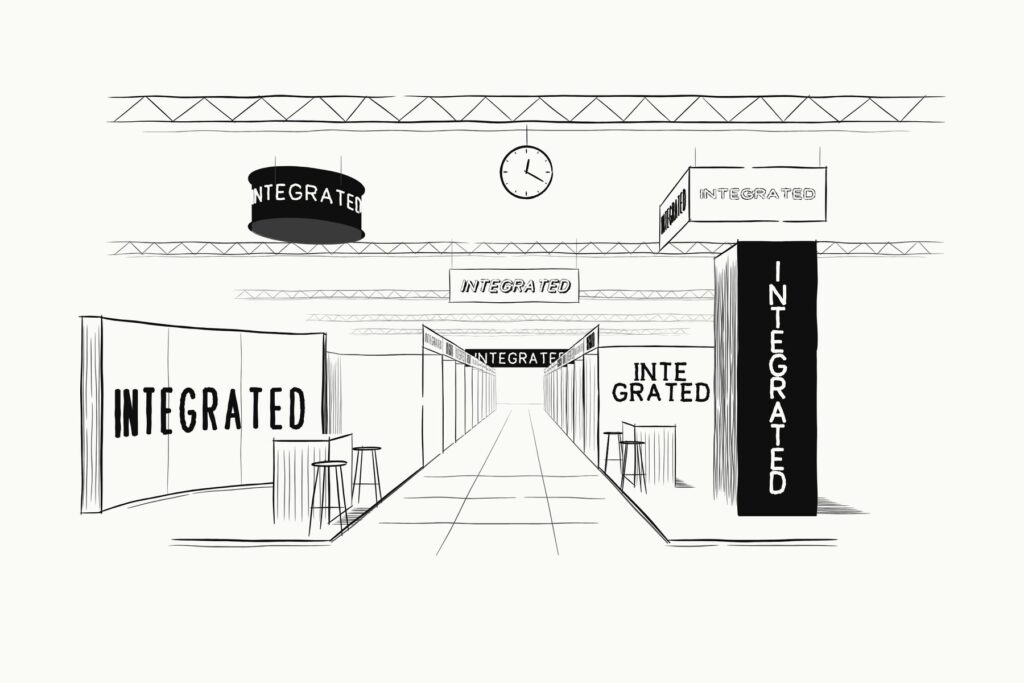
Walk any trade show floor this year and count the booths with the word “integrated” on them. I tried. I gave up somewhere around lunch.
Frankly … it’s a good problem for our industry to have. Not long ago, “integrated” was a feature you had to argue for. Now it’s on every banner, every brochure and every slide. Customers have made it clear they won’t buy islands anymore, and the industry heard them.
In September I spent time in Paris with Motorola Solutions and Avigilon colleagues from France, Italy and the UK. Three very different markets, three different languages, and one identical challenge: security and operational systems from many vendors that refuse to talk to each other. The word “integration” came up in every conversation. What people meant by it was very different from one conversation to the next.
What the buyers are telling us
The data has caught up with what partners hear in the field. In Gallagher’s new 2027 Security Industry Trends Report, system integrations are the most important feature end users look for when they choose a security system, for the second year running.
But the line in that report I keep coming back to is a different one. When end users were asked about their goals for the next three to five years, automation overtook integration as their number one goal: 20% of mentions, versus 14% for integration. A year earlier the two were tied.
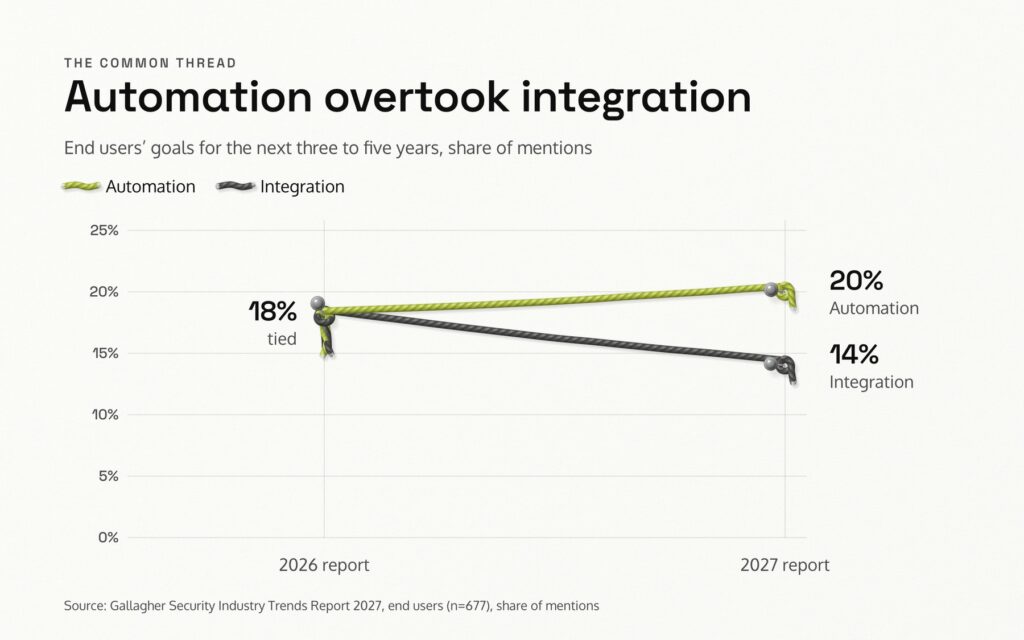
Here’s how I read it. Integration has become the entry ticket. Nobody gets credit for it anymore; you just get disqualified without it. What buyers actually want is the thing integration makes possible: systems that do something when something happens, without waiting for a person to connect the dots.
The same report found end users’ top integrations are now a five-way tie between incident management, data analysis, video, identity and visitor management. That’s not a ranking. That’s a shopping list. Security is now expected to run workflows, not just to display.
Connected is not the same as automated
Here’s a test I like, and it comes straight from the manufacturing car plants we work with. A robot on an automotive production line faults in the middle of a shift.
In a connected plant, the fault shows up on a screen. Someone sees it, picks up the radio, asks around for a mechanic who knows that machine, finds out who’s on shift, works out where they are, and sends them over. Thirty to forty-five minutes later, the line is moving again.
In an automated plant, the fault itself starts the response. The three nearest qualified mechanics get a spoken page on their radios. The first one to accept gets a work order for that exact machine, with the camera view of the line already attached. The supervisor sees it was handled. Downtime drops from the better part of an hour to a couple of minutes.
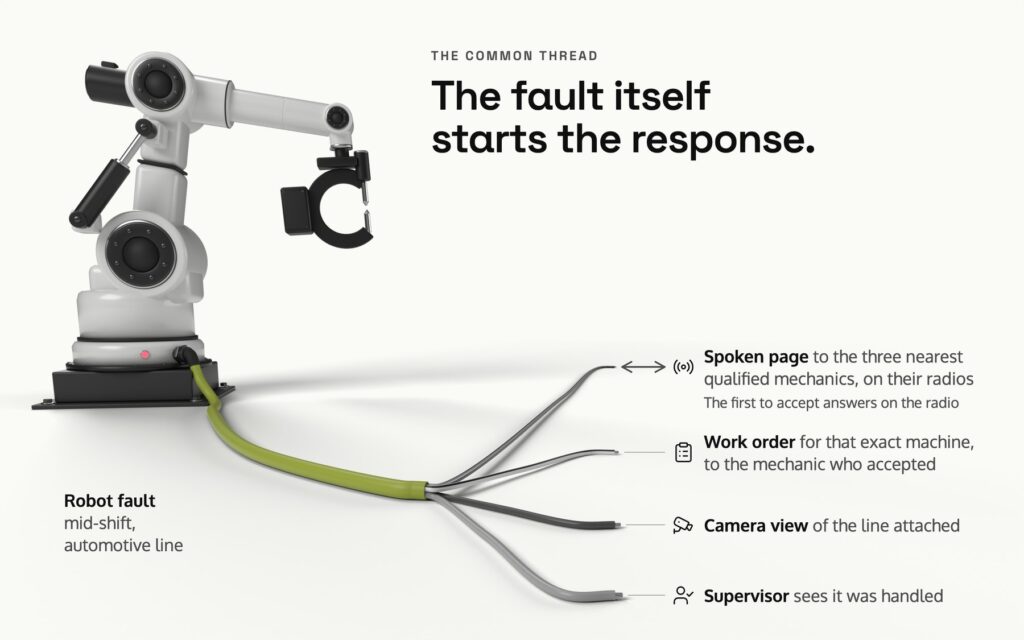
Both plants are “integrated”. Only one of them got the line moving in two minutes.
That’s the gap the industry is moving into now. Integration got everything into one place. Automation makes it act. (We made the case back in March that integration alone isn’t enough. The new Gallagher data says buyers have now reached the same conclusion.)
Five questions to ask about any “integrated” system
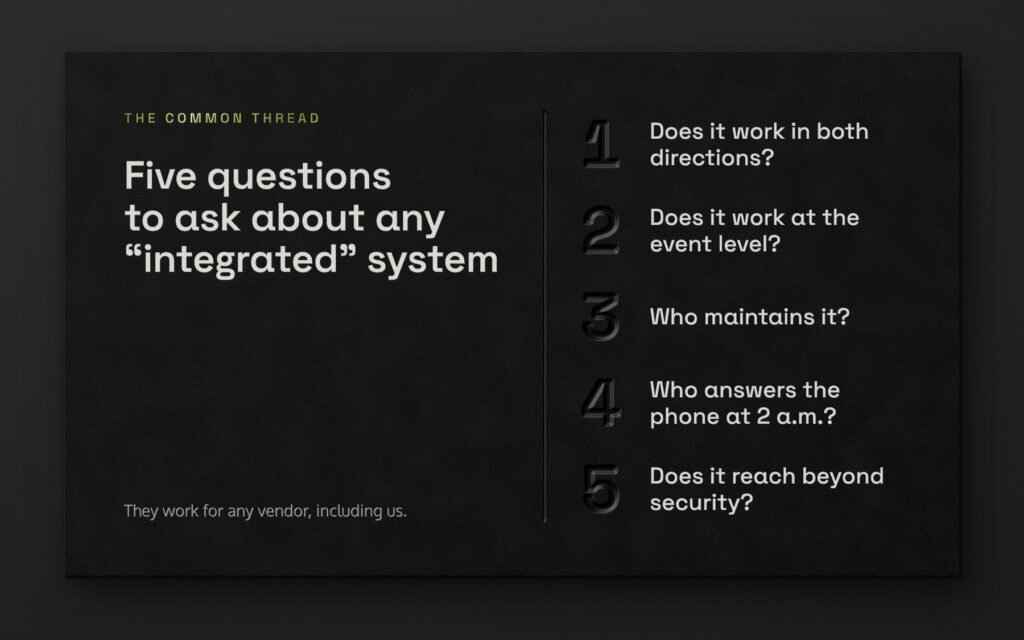
In our September Roundup we said “integrated” is now table stakes, so read the fine print. Here’s the fine print we suggest to read. Since everyone uses the same word, these are the five questions I’d ask before believing it. They work for any vendor, including us.
- Does it work in both directions? Can events flow out of your VMS and access control and into other systems, and can those systems trigger actions back? A camera tile on someone else’s screen is a view, not an integration.
- Does it work at the event level? Does the alarm arrive with its meaning: which door, which credential, which camera, which zone? Or does it arrive as “alarm 47”?
- Who maintains it? Every firmware update and every version change can break a custom integration. Is someone shipping and testing updates every month, or does it quietly rot after the integrator leaves?
- Who answers the phone at 2 a.m.? When something stops working, is there a product team behind the integration, or a script someone wrote on a weekend three years ago?
- Does it reach beyond security? Radios, people, work orders, building systems, PLCs, email and SMS. If the integration stops at the edge of the security department, automation stops there too.
If the answer to all five is yes, you have the foundation for automation. If not, you have a very nice slide.
What it looks like when the answers are yes
This is why we built Teldio Fabric the way we did.
Teldio Fabric treats every integration as a product, not a project. There are 230+ of them today, from Avigilon Unity and Alta video and access control to fire panels, intercoms, sensors, PLCs, two-way radios, phones, email and work-order systems, and our team adds new ones every month. Each one is built, tested and maintained by us, so when a firmware update lands, the workflow keeps running.
Every integration works in both directions. An Avigilon event can trigger a radio announcement, a door action and a ticket, and an acknowledgement on the radio can flow back to close the alarm and write the record. Teldio Fabric ingests each event, normalizes it into one language, applies the logic of your procedures, and routes the right action to the right system or the right person. Who is on shift and where they are is part of the routing, not an afterthought.
That’s how the robot fault becomes a two-minute fix. It’s also how a forced door gets the nearest officer, a freezer alarm gets the facilities tech, and a weather warning reaches the outdoor crews, from the same platform, without anyone writing custom glue code.
For the Avigilon partners reading this, here’s the part I like best. When the customer asks “is it integrated?”, you get to say yes and then show them what happens next. Integration is where the conversation used to end. Now it’s where it starts.
Step two
Our industry spent the last few years getting connected, and the reports say we did it. Integration is the number one feature for the second year running. Good. Step one is done.
Step two is making connected systems act on their own, safely and predictably, so people spend their time on judgment instead of relay work. The organisations that get there first won’t be the ones with the most integrations on a slide. They’ll be the ones whose integrations actually do something.
So the next time someone tells you their system is integrated, smile, say “great”, and ask the five questions above and ask them to show you the automations.
Where can we help you next?
“The Common Thread” is an occasional series on where physical security and operations is heading and what I’ve learned along the way.