If an AED cabinet in one of your outpatient wings opened right now, who would find out? And how long would it take them to find out?
For many facilities teams, the honest answer is: whenever somebody calls it in. In the hospital conversations we take part in, the pattern usually looks like some version of this. A nurse station phones the communications center. An operator there works out what is happening and where. Then the operator keys the radio and dispatches a responder. Nothing in that chain is broken, exactly. But every link in it is a person relaying information by hand, under pressure, about an event a sensor could have reported on its own.
AED cabinets and fixed panic buttons are two of the easiest places to retire that manual chain, and two of the places where retiring it matters most. This article explains why those two sensor points deserve first priority, what a monitored AED cabinet actually reports, and, for the integrators reading along, how the signal travels from a cabinet door to a radio call.
Why these two sensors first
A hospital campus is full of things you could monitor. AED cabinets and panic buttons earn first place for a simple reason: they are quiet almost all of the time, so when they do produce a signal, that signal nearly always matters.
Outside its scheduled inspections, an AED cabinet is rarely touched. When its door opens, something is happening: a medical emergency, a maintenance check, or tampering. There is little routine traffic to filter out and little alarm fatigue to manage. The same is true of a panic button mounted under a reception desk or at a nurse station. Nobody presses it by habit.
The stakes are also well documented by sources with no product to sell. The American Heart Association’s resuscitation guidelines state that early defibrillation significantly increases survival from out-of-hospital cardiac arrest, and they recommend public access defibrillation programs in communities at high risk of such arrests. The same guidelines note a quieter problem: even where AEDs are widely deployed, they often go unused (AHA Guidelines, Systems of Care). That evidence describes cardiac arrest outside hospital care. The spaces a facilities team owns (lobbies, parking structures, cafeterias, administrative wings, and outbuildings) are the parts of a campus most like that environment, because the nearest clinician may be minutes away.
Hospitals have already done the hard part of that equation. The devices are already on the walls and on an inspection schedule. What is often missing is the connection between the cabinet and the people who respond. The cabinet door opening is one of the earliest reliable signals that a cardiac emergency may be underway somewhere in your building. If that signal only exists as a door swinging on a hinge, your response still starts with a phone call.
What a monitored cabinet and a panic button actually report
A monitored AED cabinet is not a single alarm. Done properly, it is a two-stage sensor, and the two stages mean different things.
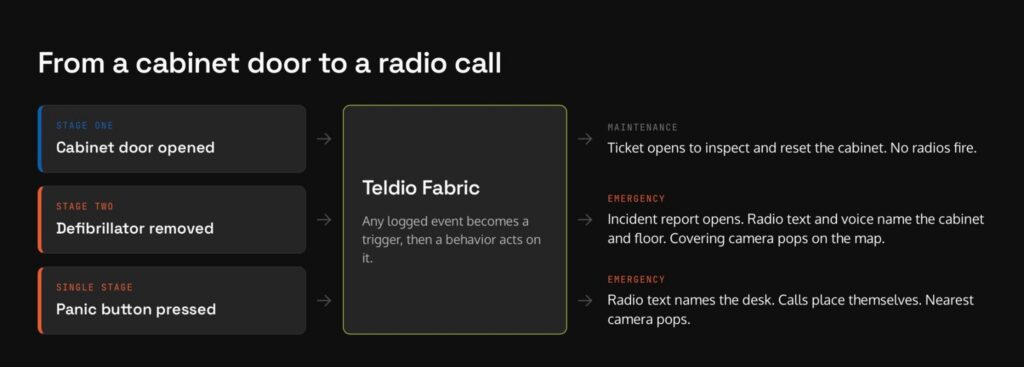
Stage one: the cabinet opened. On its own, an open door is ambiguous. It might be the start of an emergency, or it might be a curious visitor or a scheduled inspection. Operationally, though, an opening typically leaves work behind: on most monitored cabinets, someone has to go out afterward to inspect the cabinet and reset the sensor. That is a maintenance event, and it can generate a maintenance ticket automatically the moment the door moves. No emergency is assumed and no radios go off. The work simply gets logged and assigned.
Stage two: the defibrillator was removed. This is a different signal entirely. Someone did not open the door to look; they took the device. Now the workflow treats it as an emergency in progress: an incident report opens automatically, and an alert goes to the response team over the radio with the location attached. The camera covering that spot can surface automatically on a map view for whoever is watching, and the alert can name the floor, because a fixed cabinet’s location, floor included, is part of its configured identity. Responders are not left searching three lobbies stacked on top of each other.
Outcome: the first minutes of a possible cardiac emergency start with responders moving toward a known location with video context, instead of a communications center reconstructing events from a phone call.
Panic buttons follow the same pattern with less ambiguity. A press is always an emergency signal. The button can send a radio text, place phone calls, and pop the nearest camera, all from the single press, and the message can name the exact station or desk that triggered it.
Outcome: a panic button stops being a local bell and becomes the first step of a response that is already in motion by the time anyone picks up a phone.
For integrators: how the sensor becomes a workflow
This section is for the person who will actually wire this together.
Event sources. The cabinet side is deliberately unexciting. Commodity network-connected contact sensors cover the two stages described above: one detecting the cabinet door opening, and a second detecting the defibrillator being removed. Where cameras with a built-in Z-Wave hub are already deployed, such as recent Avigilon H6-family cameras (the H6XP models), a Z-Wave door contact can report through the camera itself, which saves a cable run.
Ingestion. The connective layer in these workflows is Teldio Fabric, a software-based middleware platform that treats any logged event as a potential trigger. If the sensor, panel, camera, or building system produces a log entry over a supported protocol (the library spans 200+ third-party integrations, from access control platforms like Gallagher to OPC UA and MQTT), Teldio Fabric can ingest it and act on it. Teldio has been a Motorola Solutions technology partner since 2008, and radio delivery is the part of the chain it has spent the longest building.
Behavior logic. Workflows are built as behaviors: if-this-then-that rules whose condition fields come from the triggering system itself. A concrete pair for an AED estate looks like this. IF the cabinet contact opens, THEN create a maintenance ticket to inspect and reset the cabinet. IF the device-removal contact triggers, THEN open an incident report, send a radio text and a text-to-speech voice announcement to the safety channel naming the cabinet and floor, and pop and bookmark the covering camera in the video management system, whether that is Avigilon Unity or Avigilon Alta. Because every removal begins with an opening, a genuine emergency produces both: the escalation for responders and the ticket that gets the cabinet reset and back in service.
Scale. Behaviors follow a write-once deployment model. You build the cabinet workflow once and apply it across every cabinet on the estate; you are not rebuilding logic per device. Before go-live, a built-in simulator fires test events through the full chain, and a debugger shows the logs of every connected system in one view, with the failing step highlighted when something breaks. That matters on a hospital project, where commissioning windows are short and the systems under test are life-safety systems.
Radio delivery. On MOTOTRBO systems, alerts arrive as radio text and voice announcements on the channels the response team already monitors. Facilities running other radio fleets should treat delivery as a design question for their dealer, since the right path depends on the fleet. Alerts can also fan out to SMS, phone calls, and ticketing systems in the same behavior.
Outcome: the integration work is configuration against systems the hospital already owns, and the workflow is testable end to end before anyone relies on it.
The conversation to have with your dealer
Most of what this workflow needs is already installed: the AED cabinets, the panic buttons, the radios on responders’ belts, and the cameras in the hallways. The additions are the sensors themselves and the mapping between the systems, and scoping both is a conversation. Bring your radio dealer or security integrator four questions.
- Which of our AED cabinets and panic buttons can produce a loggable event today, and what would instrumenting the rest cost?
- What is the path from those events to our radios?
- Can our communications center see these events on a map, with the nearest camera attached?
- What should happen automatically afterward, from maintenance tickets on stage-one openings to incident reports on device removals?
A dealer who can answer those four questions can often show you the workflow running against your own floor plan. That demonstration, not another device purchase, is the fastest way to shorten the distance between a cabinet door opening and the right person walking through it.