
On game day, venue teams are spread across concourses, gates, tunnels, service corridors, parking areas, restricted zones, and command centers. The radios may work, the cameras may be live, and the event plan may be ready.
But one question still matters: Where are the people who can respond?
For stadiums, arenas, and major event venues, communication alone does not always give command teams the visibility they need. During a high-attendance event, knowing where teams are positioned and how quickly the right person can respond can make the difference between coordinated action and a slower manual search. That is why staff location tracking should be tested before game day, so venues can prove coverage, meet IT requirements, and support real operations before the crowd arrives.
Why Staff Location Visibility Matters During Major Events
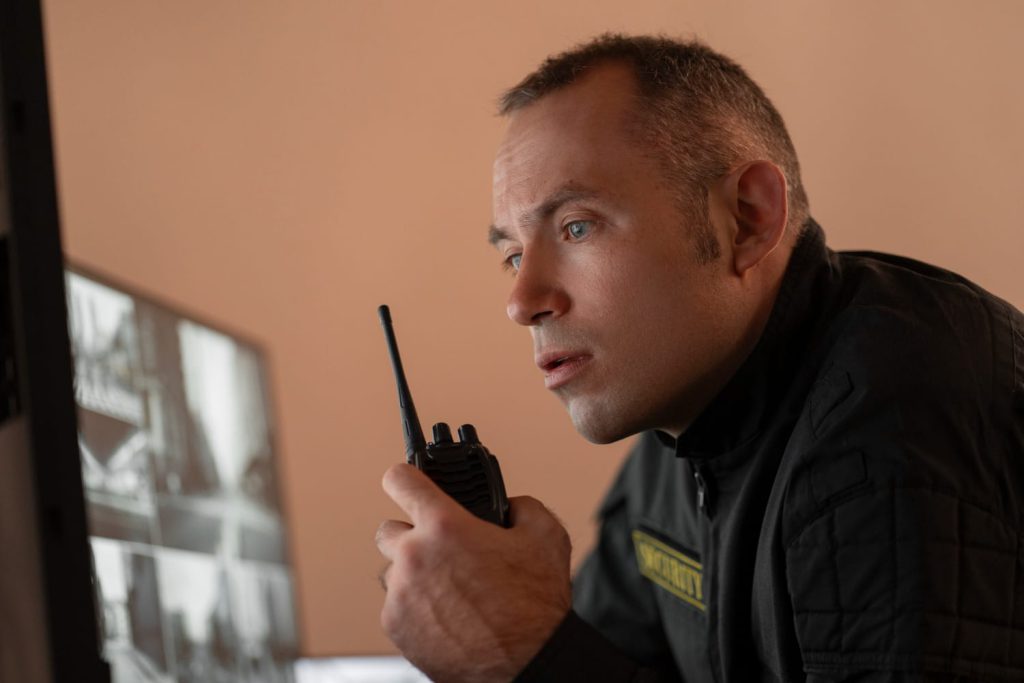
During a major event, venue operations depend on movement. Staff are not fixed to one location; they rotate through assignments, respond to calls, support incidents, cover crowd-heavy areas, and move between indoor, outdoor, public, and restricted spaces as conditions change. Without location visibility, command teams may rely on radio check-ins, manual updates, or assumptions about where people are supposed to be. That may work during routine operations, but high-attendance events create more movement, more urgency, and less room for uncertainty.
Staff location visibility helps teams make faster dispatch decisions, coordinate supervisors, support parking and guest services, improve incident response, and maintain clearer visibility across indoor, outdoor, and restricted spaces.
The core value is not “simply seeing a dot on a map”; it is giving command teams better operational context when they need to act. That was the central idea behind this major-venue use case: understanding where radio users are in and around a complex stadium environment before high-pressure event conditions arrive. Major events require more than people. They require visibility into where those people are.
That is the role Teldio TruFleet can support in a major venue environment: helping teams understand where radio users are in and around a complex stadium before high-pressure event conditions arrive.
Why GPS Alone Is Not Enough in a Stadium
GPS can be useful in outdoor areas such as parking lots, perimeter zones, yards, and open spaces. But stadiums are not flat, open environments. A person may appear close on a map while actually being one level above or below, near a tunnel entrance but not inside it, or physically close to an incident but separated by a wall, gate, or level change.
For command teams, those are important details. “Near the building” is not enough; teams need location visibility that reflects how the venue is built. So indoor tracking needs additional reference points, whether through dedicated Bluetooth beacons or compatible HPE Aruba Wi-Fi access points that can support BLE beacon functionality where the environment allows.
Stadiums also have horizontal and vertical splits, while crowd traffic, concrete, steel, and elevation changes can affect signal behavior between radios and beacon sources. Real venue testing helps determine where GPS is sufficient, where indoor reference points are needed, and whether existing infrastructure such as HPE Aruba access points can be leveraged as part of the location strategy.
Why Bluetooth Beacons Matter Indoors
Bluetooth beacons help close the indoor visibility gap by providing location reference points inside the venue.
Instead of relying only on GPS, radios can detect nearby beacon signals and report that location context back through the radio network. This is especially useful in heavily walled areas, like tunnels, suites, stairwells, and back-of-house spaces where GPS alone may not provide enough detail.
But beacon planning is not just a hardware count. Stadium environments include lots of concrete, steel, elevation changes, walls, crowd density, and signal interference, all of which can affect BLE signal behavior. Beacons should be understood as a practical visibility layer, not a promise of perfect precision. The goal is to help teams understand where people are with enough context to support operations, which is why beacon planning should be treated as an important operational and venue-readiness exercise.
How Radios Become Location-Aware Operational Tools
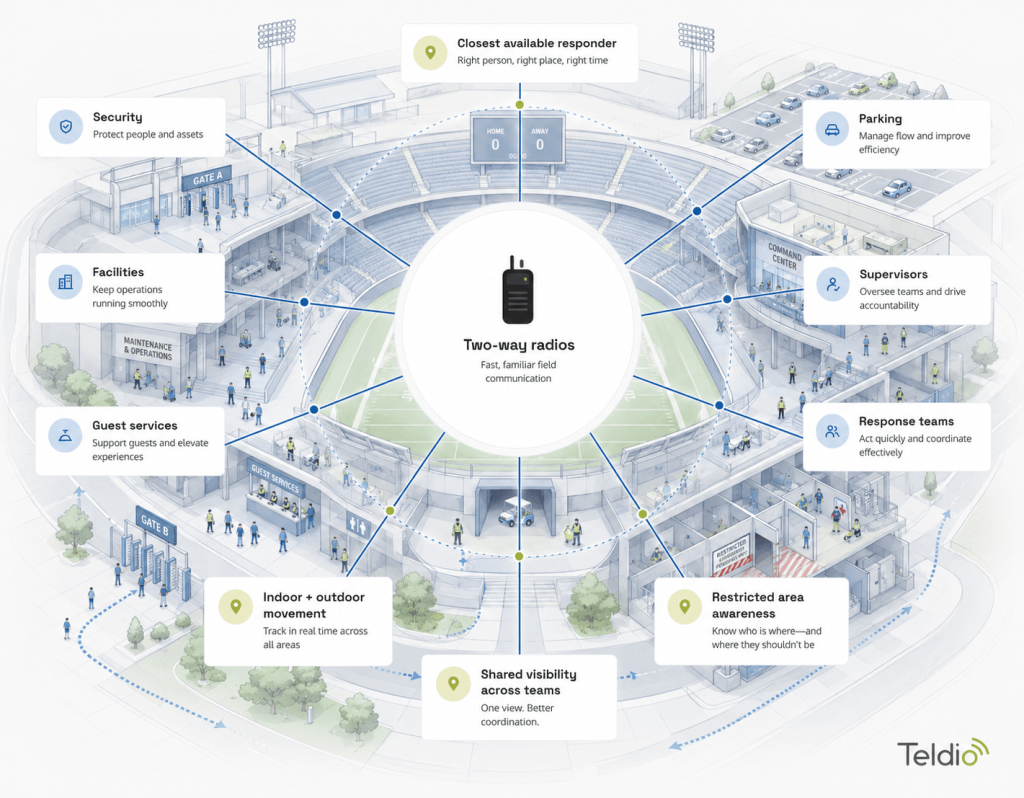
Radios already sit at the center of venue operations.
Security, facilities, guest services, parking, supervisors, and response teams rely on them because they are fast, familiar, and built for field communication. Staff location tracking adds another layer of value by turning radios into location-aware operational tools that help command teams understand where the staff are across the venue.
That context matters when supervisors need the closest available medical responder, when a security issue occurs in a restricted area, or when staff move between indoor and outdoor zones.
With Teldio TruFleet, that radio-based location data can become part of the command team’s operational view, helping teams coordinate response by role, zone, or proximity.
To be clear, location does not replace voice communication; it adds context. Instead of sending every alert to an entire talk group or every radio on the system, command teams can route information to the right role, zone, or nearby responders. A facilities alert, for example, may need the closest maintenance staff. A medical call may need the nearest qualified responder. A restricted-area security issue may need the right security team, not every radio user in the venue.
Why Validation Matters Before Full Deployment
The best time to test location visibility is before a major event, not during one.
Validation helps venues answer practical questions: where GPS works, where it fails, which indoor areas need beacon support, how many beacons are required, how tracking behaves across multiple levels, what the command center needs to see, what IT must approve, and what changes between demo, setup, and production.
A PoC or structured validation phase reduces uncertainty before the system is expected to support a high-pressure environment. Moving too quickly without testing real venue conditions can lead to scrambled data points or location updates that do not reflect actual positions.
Validation turns location tracking from a promise into operational evidence.
Why Network and IT Requirements Shape the Deployment
Major venues often have strict IT and security requirements, so staff location tracking must fit the customer’s environment rather than require unnecessary access. IT teams need to know where the server runs, what network access is required, whether remote vendor access is allowed, which software components must be installed, and how the system behaves without internet dependency.
Radio programming, server setup, and testing must be coordinated carefully before Teldio TruFleet can go online. Server readiness requires the right networking and Motorola applications, with MNIS and DDMS interacting with repeaters to ensure data flows from the radio to the server. Teldio TruFleet databases and licensing must also be in place before configuration begins.
This is not just technical background; it is part of event readiness.
If server setup, radio programming, firewall requirements, or beacon configuration are not ready, deadlines can slip. Common issues include firewall or port problems, radio programming errors, mismatched data points, incorrectly configured infrastructure, and beacon configuration errors that cause range or frequency issues.
A strong deployment model must support operations while remaining acceptable to IT.
From Setup to Game-Day Readiness
Moving from setup to production should be deliberate. A working configuration is not the same as game-day readiness.
Major venues need to validate outdoor GPS behavior, indoor beacon performance (a function of beacon placement), radio update behavior, server or VM readiness, network and firewall requirements, maps, viewing workflows, and support responsibilities.
Radio infrastructure is especially important. Radio networking must be completed before Teldio TruFleet can run on top of it, and Bluetooth beacons must be configured throughout the stadium for indoor location tracking. Using dedicated data repeaters alongside a voice repeater can also improve performance for both tracking and communication.
The deployment model changes when broad remote access or internet connectivity is unavailable. Teldio TruFleet may need to run on a local server, with manually supplied map data and zoomed-in images replacing the precision that internet-dependent services might otherwise provide automatically.
That is why validation must extend beyond the location-tracking interface. It needs to include the underlying architecture. From a configuration and deployment standpoint, “ready for game day” means Teldio TruFleet is running optimally for several days before it is needed, with stress testing completed across different scenarios.
The demo or initial setup proves the use case. The production architecture makes it dependable.
Game Day Visibility Starts Before Game Day
Stadiums, arenas, and major event venues should not wait until the crowd arrives to learn whether GPS, beacons, radios, maps, servers, and network constraints work together.
A tested deployment gives command teams confidence that when the event starts, they know where their people are. Teldio helps major venues connect radio systems, GPS, Bluetooth beacons, mapping, and operational workflows so teams can validate staff location tracking before game day.
Talk to Teldio about validating staff location tracking before your next major event.