TLDR
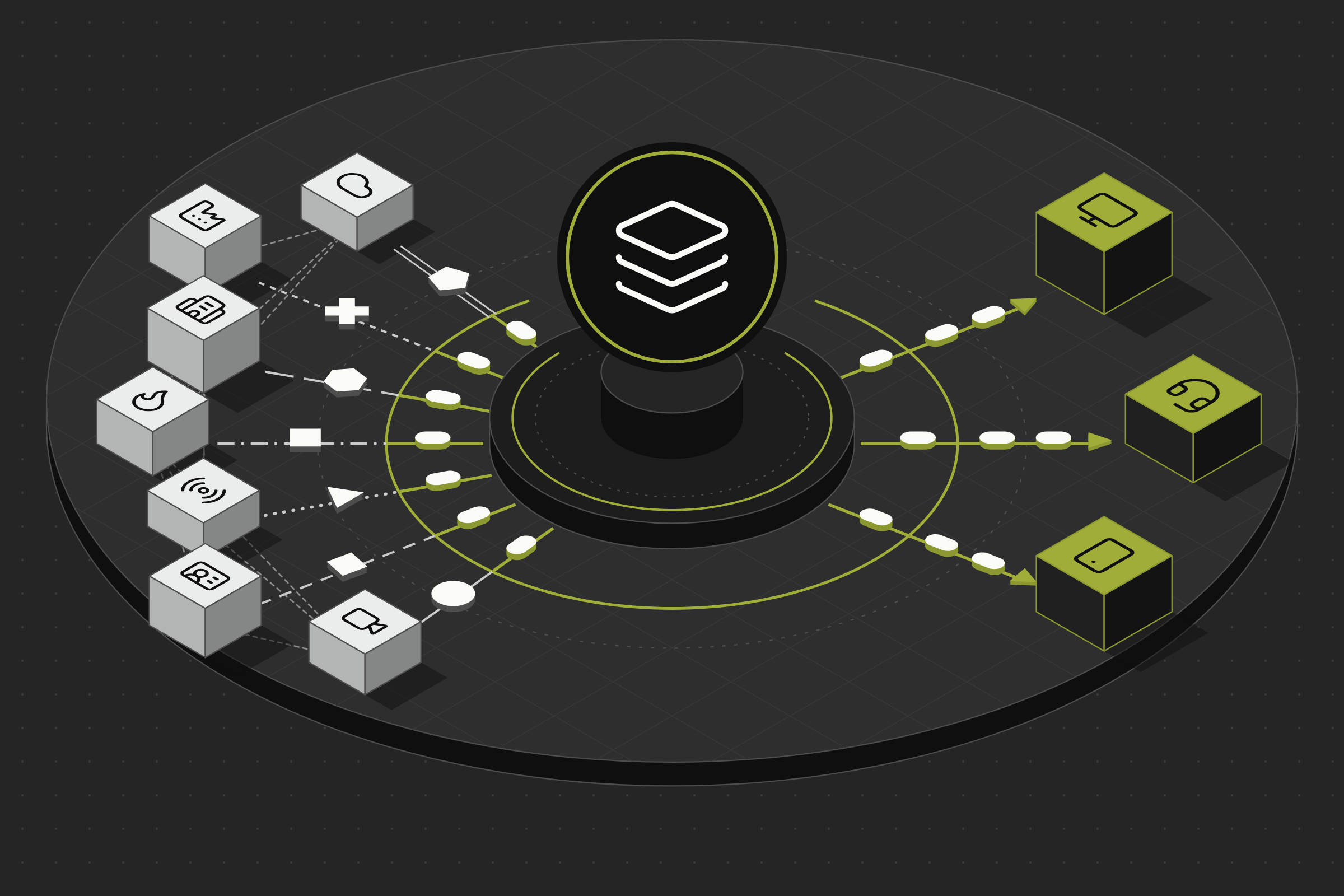
A physical security integration platform is software that connects compatible security and operational systems through a common workflow layer. It normalizes supported event data and routes approved actions across systems. It can operate independently or provide a core integration capability within a PSIM, reducing manual handoffs and reliance on one-off integrations.
Why security systems struggle to work together
Most facilities operate technology from several vendors. A video-management system may run alongside a separate access-control platform, two-way radio network, fire and intrusion panels, building systems, industrial controls, and cloud services. Each system was selected for a specific function, often at a different point in the facility’s lifecycle.
Acquisitions, phased upgrades, changing vendor relationships, and cloud migrations make that mixed environment a normal part of operations. The challenge appears when an event must move across those systems. An operator may need to identify an alarm in one interface, locate the associated camera in another, and relay the details by radio. Those manual handoffs add work and can delay delivering usable context to the responsible team.
Where direct integrations create complexity
A direct or native integration can be the right solution for a stable, well-supported product pair. Complexity grows when an organization accumulates many separate links, each with its own authentication, data model, configuration, testing requirements, and support owner.
Firmware updates, API changes, cloud migrations, and revised security requirements may require reviewing and retesting each connection. Documentation and ownership may also vary from one integration to the next. A common integration layer gives the organization a more consistent way to manage supported connections and workflows as the environment changes.
What a physical security integration platform does

A physical security integration platform sits between compatible source systems and the systems or teams that need to act. Instead of building a new connection for every workflow, each supported system exchanges information through the platform. Four capabilities provide a useful framework for evaluating the category.
- It connects supported systems. Vendor integration modules, APIs, and industry-standard protocols provide defined integration paths across video, access control, communications, alarms, sensors, building systems, and other operational technology. Compatibility still depends on the product, version, licensing, available data, authentication, and supported commands; a shared protocol alone does not confirm an integration.
- It normalizes event data. Vendors use different structures, names, identifiers, and severity models. The platform maps supported data to a consistent schema while preserving the source context the workflow requires. The originating platform remains the system of record for its event and priority.
- It executes approved workflows. Organization-defined logic determines what happens when a supported event meets configured conditions. The platform can route permitted context or actions to designated systems and teams, while trained personnel retain control wherever judgment, verification, or authorization is required.
- It supports a unified operational view. By exchanging supported data from both legacy and newer systems, an integration platform can provide PSIM and AI-enabled operations tools with more consistent context. The usefulness of that view depends on available integration data, source-system quality, and the receiving tool’s capabilities.
How it differs from PSIM
Physical Security Information Management, or PSIM, typically integrates information from multiple security systems into a common operator environment and supports incident management procedures. A physical security integration platform emphasizes exchanging, normalizing, and routing events and actions between systems and communication endpoints.
The categories overlap: a PSIM may automate actions and notify field personnel, while an integration platform may include dashboards or operator views. The practical question is whether the organization needs consolidated operator visibility, repeatable cross-system workflows, or both, and whether those capabilities should be delivered by one platform or by complementary layers.
How it differs from native integrations and custom middleware
A native integration is a supported link between two products. It can offer valuable functionality and clear vendor ownership when the pairing matches the required use case. Its scope remains limited to the products, versions, events, and actions the vendors support.
Custom middleware is purpose-built for a particular environment or workflow. It can address specialized requirements, but the organization must define who owns maintaining the code, documentation, credentials, testing, security reviews, and future compatibility.
An integration platform turns many recurring integration tasks into configuration on a supported product. It still requires product validation, governance, testing, and lifecycle management; its advantage is a reusable architecture for multiple supported systems and workflows.
Where Teldio Fabric fits
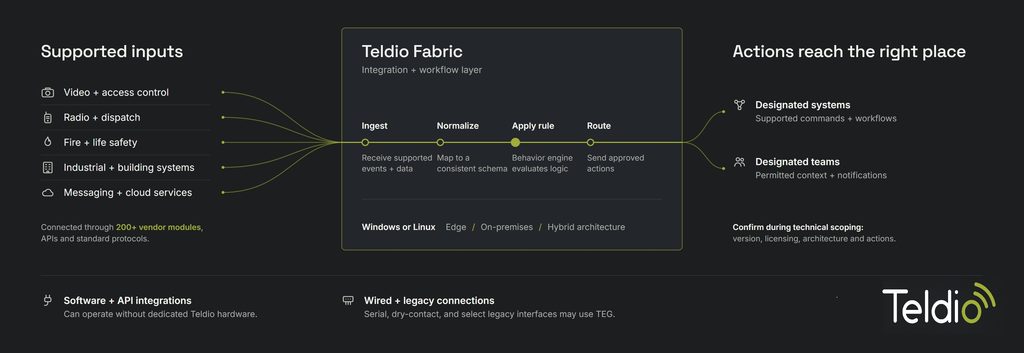
Teldio Fabric is a software-based platform for physical security integration and workflow. It connects supported video, access control, radio, fire and life safety, industrial, building, and messaging systems through vendor modules, APIs, and industry-standard protocols. Its Behavior Engine applies organization-defined rules to normalized events and routes approved actions to designated systems and teams.
Teldio Fabric uses a decoupled, module-based architecture to limit direct dependencies between connected systems. When a product, API, or configuration changes during an upgrade, teams can isolate the affected module and workflows for review and testing. This can make the scope of corrections and improvements easier to identify and implement without redesigning unrelated integrations. All changes still require validation in the confirmed deployment architecture.
Teldio Fabric supports more than 200 vendor modules and Windows or Linux deployments at the edge, on-premises, or in a hybrid architecture. Supported software and API integrations can operate without dedicated Teldio hardware. The Teldio Edge Gateway may support wired, serial, dry-contact, and certain legacy connections. Exact compatibility and available actions depend on product version, licensing, architecture, and the confirmed integration scope.
Teldio’s published integration ecosystem includes platforms such as Avigilon Unity and Alta, Honeywell Pro-Watch, AMAG, Gallagher, Avtec dispatch, Motorola MOTOTRBO, and Motorola WAVE. Teldio confirms the exact product version, supported event types, available commands, licensing, and architecture during technical scoping.
When an organization may need an integration platform
An organization should investigate an integration platform when manual coordination has become a routine part of incident response or system maintenance. Common signals include operators moving between multiple interfaces to understand a single event, dispatchers relaying information from screens to field teams, separate integrations with unclear ownership, integrations or configurations breaking during upgrades, repeated retesting after product changes, and inconsistent workflows across sites.
Start the business case with one high-value workflow. Map the source event, systems of record, manual handoffs, required context, responsible roles, supported integration points, cybersecurity requirements, and expected actions. That process reveals whether an integration platform addresses the operational gap and establishes a practical scope for validation.
What to evaluate before choosing a platform
- Supported products, versions, licenses, events, data fields, and commands
- Integration depth, including bidirectional actions and acknowledgment handling
- System-of-record ownership and the treatment of source priorities and audit data
- Deployment architecture, network boundaries, hardware requirements, and downtime behavior
- Authentication, encryption, role-based access, logging, credential management, and change control
- Connector maintenance, technical support, testing responsibilities, and upgrade validation
- Workflow ownership, approval, escalation, and the points where personnel retain judgment
A physical security integration platform should make supported cross-system workflows easier to understand, configure, test, and maintain. Talk to Teldio about mapping one operational workflow and confirming how Teldio Fabric can connect the systems involved.
FAQs
What is a physical security integration platform? It is software that connects compatible security and operational systems through a common layer, normalizes supported event data, and routes configured actions to designated systems and teams.
How is it different from PSIM? PSIM commonly emphasizes consolidated operator visibility and incident management. An integration platform emphasizes event exchange, normalization, and cross-system workflows. Their capabilities can overlap, and the two can work together.
Is it the same as a native integration between two vendors? A native integration connects a specific product pair. An integration platform provides a reusable layer for multiple supported products and workflows while still relying on validated modules, APIs, or protocols.
Do I have to replace my existing systems? Not necessarily. Compatible, supportable systems can remain connected while the organization modernizes workflows. Product compatibility, cybersecurity risk, support status, and lifecycle priorities determine what can remain, be isolated, be upgraded, or be replaced.
Where does Teldio Fabric fit? Teldio Fabric is a software-based platform for physical security integration and workflow. It connects supported systems, normalizes event data, applies organization-defined Behavior Engine rules, and routes approved actions across systems and teams.