
Your radios are not broken. The process around them is.
Organizations can make a significant investment in two-way radios and still lose track of who has each device. Radios get passed between employees, spares are taken without being logged, and units go home after shifts or end up in lockers, trucks, drawers, and break rooms.
For operations managing hundreds of devices, that uncontrolled circulation creates missing equipment, unclear custody, wasted time, and reduced readiness.
Many organizations respond with sign-in sheets, checkout logs, supervisor reminders, charging cabinets, return policies, and inventory sweeps. These controls can help, but only when every handoff is recorded consistently.
Having a policy is different from having an accountability loop teams can actually use. You’ll need answers to questions like: “Can we identify who has each radio, its reported location, and whether it has left the site without approval?”
Operations leaders need a practical workflow that protects the fleet without slowing the team down.
The Real Problem Is Lost Custody.
A missing radio is the visible symptom. The deeper problem is the loss of traceable custody over a shared operational asset.
When radios circulate informally, teams may not know whether a device is assigned to the correct person, available for the next shift, off-site, or sitting unused somewhere in the operation. Supervisors may know how many radios the organization owns without knowing how many are actually available to staff.
The result is a familiar cycle. A device goes missing, a supervisor checks the charging cabinet, messages employees, searches common storage areas, and tries to reconstruct who last used it. Meanwhile, the next shift may need to share radios or operate with fewer devices than expected.
Radio accountability is therefore an operational-readiness issue. Addressing it requires traceable custody as radios move between users, shifts, roles, vehicles, and locations.
Why Manual Sign-In Systems Break Down

Manual checkout systems are easy to understand but difficult to sustain because they depend on consistent behavior during the busiest parts of the day.
At shift change, people are arriving, leaving, receiving briefings, finding equipment, completing handoffs, and moving quickly. A process that appears simple on paper can introduce enough friction that employees begin working around it.
Someone forgets to sign out. Another person grabs a spare because the checkout line is slow. A radio is returned without the sheet being updated, or a device assigned to one employee is later handed to someone else.
The issue is not necessarily that staff refuse accountability. The process simply asks them to complete extra steps when their attention is focused on starting or finishing the work.
Once the record becomes incomplete, supervisors stop trusting it. They return to asking who had the radio last, whether it went home, or whether it was left in a vehicle. An accountability process people find burdensome will eventually become one they bypass.
The Three Workflows That Bring Accountability Back
Better radio accountability usually comes from workflow design, not another manual rule. Teams need a process that makes custody visible, identifies exceptions, and gives supervisors a clear path for follow-up.
Teldio TruFleet Plus can support this approach by connecting radio assignments, location information, geofence exceptions, and device-control workflows. Three capabilities are especially important.
Assignment Visibility
Teams need a reliable way to understand which radio is associated with which user, role, shift, department, vehicle, or post. Assignment visibility reduces the “who had this last?” problem and gives supervisors a stronger starting point when a radio is missing or associated with the wrong assignment.
The right model will differ between operations. A manufacturing facility may assign radios to individual employees or shifts. A school district may assign devices by building or role. A warehouse, hospital, solar facility, or major venue may organize radios by department, vehicle, zone, or operational post.
Not every organization uses the same model. The assignment model reflects how radios actually move through the operation.
Geofence-on-Exit Alerts
When a compatible, location-enabled radio reports that it has crossed a configured boundary, the system can create an exception for operations to review. This is particularly useful when radios are taken home accidentally or are expected to remain within a facility or site perimeter.
Instead of discovering the missing unit during the next inventory sweep, the team can receive an alert while the event is still recent.
For example, if a radio associated with a shift user crosses the site geofence after that shift and has not been approved for off-site use, operations can receive an alert. A supervisor can then confirm whether the device was taken by mistake and determine what follow-up is appropriate.
The value here is knowing that a radio moved soon enough to take useful action.
Stun-and-Revive Control
When an unauthorized or missing radio should not remain operational, stun-and-revive functionality can provide another control point. Subject to radio compatibility, network connectivity, system configuration, and organizational authorization, an approved team may be able to disable the device and reactivate it after it is recovered or cleared for use.
This capability should be governed by a clear policy. Employees should understand when a radio may be disabled, who can authorize the action, and what must happen before the device is reactivated.
Used carefully, stun-and-revive control can help prevent unauthorized use without requiring supervisors to constantly police the fleet manually.
Together, these three workflows create a practical accountability loop: establish custody, maintain location awareness, identify exceptions, and take appropriate action.
What Happens When a Radio Walks Off Site
The difference between a manual process and an exception-based workflow becomes clear when a radio leaves the site.
Without a dependable workflow, nobody may notice immediately. The next shift starts short one device, a supervisor searches the cabinet and messages employees, and the radio may return tomorrow, next week, or not at all. Until then, someone may have to share a radio, use a spare, or begin work without the communication tool intended for the role.
With an accountability workflow, a reported boundary crossing can create an exception. The team can identify the device, review the user, role, vehicle, or shift associated with it, and determine the appropriate response.
If the radio should not remain operational, an authorized team may also be able to disable it rather than waiting for the problem to surface later.
Manual follow-up may appear manageable with a small fleet. As more devices enter circulation, automatically surfacing exceptions becomes much more valuable.
How to Build a Radio Accountability Process People Can Live With
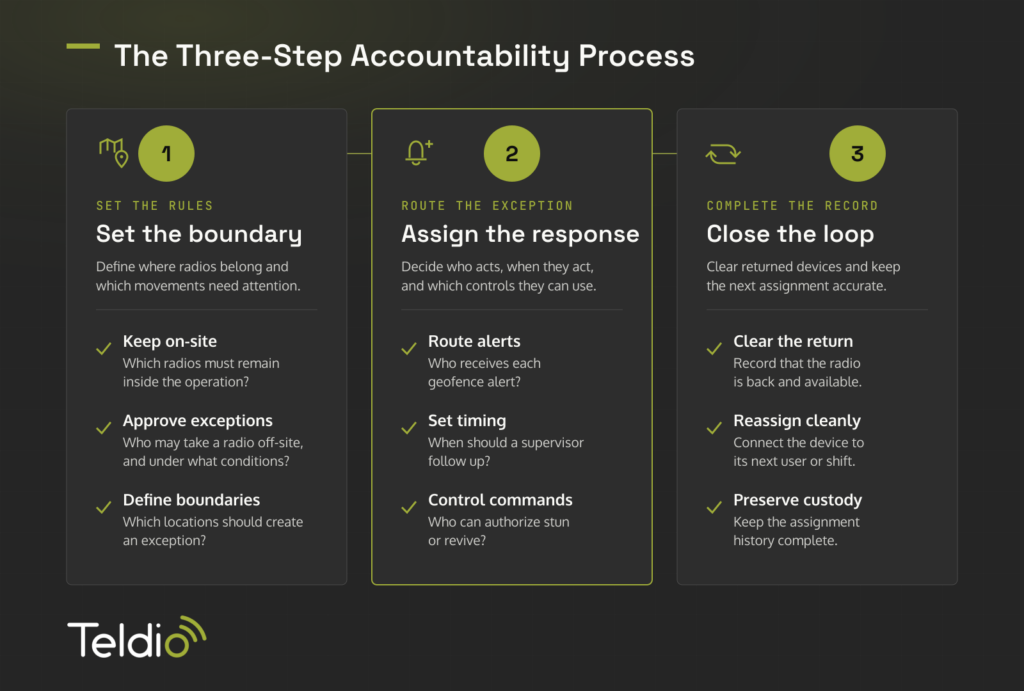
Technology works best when paired with a clear, lightweight process. The goal is to provide enough reliable information to manage the fleet without burdening employees or supervisors.
Start by choosing an assignment model that reflects how radios already move through the operation. Then establish:
- Which radios must remain on-site
- Who may take radios off-site and under what conditions
- Which boundaries or locations should create exceptions
- Who receives geofence alerts
- When supervisors are expected to follow up
- Who can authorize a stun or revive command
- How returned devices are cleared and reassigned
The system should surface the exception, while supervisors provide judgment, context, and follow-up.
If the process remains too manual, people will work around it. If it feels unnecessarily punitive, employees may resist it. But when the workflow clarifies expectations and reduces time spent chasing equipment, accountability becomes easier to maintain.
Why Radio Accountability Matters Beyond Replacement Cost
Lost radios cost money, but replacement cost is only part of the business case.
A missing device can slow a shift handoff, reduce communication coverage, force staff to share equipment, and weaken emergency readiness. Supervisors may spend time searching for radios instead of managing operations, while spare units can gradually enter the same informal circulation that caused the original problem.
Radios are not just pieces of equipment. They are part of how work gets coordinated. When a device is unavailable, associated with the wrong assignment, or off-site when it should not be, the organization loses more than hardware. It loses time, readiness, and confidence in the fleet.
The cost of a walking radio is not only the radio. It is the operational friction left behind.
Shared Radios Still Need Traceable Custody
Radios may be shared tools, but their custody still needs to be traceable.
If a radio can leave the site without anyone knowing, the organization does not simply have an inventory problem. It has an accountability gap.
Teldio Fabric IMS and Teldio TruFleet work together to close that gap. Teldio Fabric IMS provides the assignment record, checkout status, return history, sign-in controls, and audit trail. Teldio TruFleet adds the reported location and geofence awareness needed to identify unexpected movement.
If your operation already depends on two-way radios, Teldio can help make those devices easier to assign, track, secure, and manage.
Contact Teldio about combining Teldio Fabric IMS and TruFleet to improve radio accountability.