
Connected Operations in Healthcare | Article 2 of 3
During a hospital shift:
→ A patient presses the nurse call button for assistance.
→ The source system records the event immediately.
→ The communication workflow must then carry the event type, room, source priority, and assigned role to the appropriate endpoint.
For a Nurse Manager or Clinical Operations Lead, this means ensuring that each approved notification reaches the role responsible for acting on it without adding unnecessary noise.
Broadcasting every event to every radio or handset creates more interruptions and obscures ownership. Deliberate routing gives each hospital-approved notification a defined destination, so the responsible role receives usable context while the source system retains its clinical priority.
Why Sending Every Event to Every Device Creates More Noise
Different events belong to different units, roles, shifts, and response teams. A patient-room assistance call may belong to:
- the assigned care team
- a facilities request to the maintenance team, and
- a duress event to security.
Broadcasting all three across every device forces staff to sort messages unrelated to their assignments.
Role-based hospital alert routing gives each event a defined audience and action path. Staff receive the context they need for their responsibilities, while supervisors can see who was notified and whether escalation started.
Separate Alarm Priority from Notification Routing
That model depends on an important boundary. The nurse-call or other source platform remains the system of record for its event. It generates, classifies, displays, and records alarms or operational signals. The hospital’s clinical and governance teams determine which events warrant a secondary notification and how to prioritize them.
Teldio Fabric acts only on supported events approved for integration. It preserves the source priority, forwards the configured context, and routes the secondary notification. The source system and hospital retain responsibility for medical significance, alarm presentation, suppression, and clinical decisions.
How a Hospital-Approved Routing Workflow Can Help
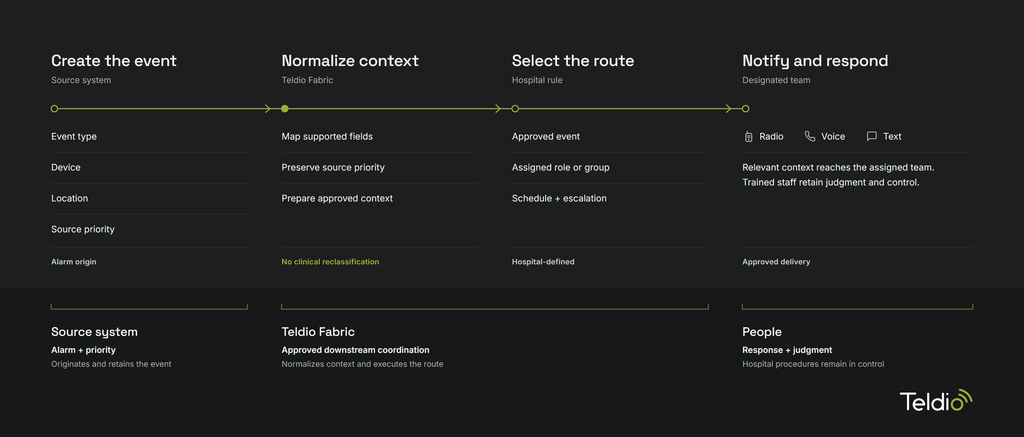
Teldio Fabric provides the integration and workflow layer between supported source systems and communication endpoints. Its modules ingest approved events and map event type, device, location, and source priority into a consistent schema. The Behavior Engine applies hospital-defined rules and routes the resulting action. Teldio’s published ecosystem includes Avtec dispatch, Motorola MOTOTRBO, Twilio, and SMTP email. Product version, licensing, architecture, and the approved integration scope determine the functions available in each deployment.
Consider an approved patient-room assistance event from a supported nurse-call source. Teldio Fabric receives the source priority and room location, applies the unit’s routing rule, and sends a text or text-to-speech notification to the designated MOTOTRBO group. Avtec dispatch surfaces the event for coordination. Recipients receive the event type and location permitted by hospital policy.
The source platform owns the event and its priority. Teldio Fabric coordinates downstream notifications and records workflow actions. The result is a selective, accountable communication path governed by the hospital.
Escalate When the Approved Condition Is Met
When a supported integration returns acknowledgment or status data, the Behavior Engine evaluates the hospital-defined timer. If the notification remains unacknowledged at the approved threshold, Teldio Fabric sends the next configured action to a backup role or group.
The hospital defines the timeframe, recipients, message, escalation sequence, and stopping condition. Receipt acknowledgment and clinical resolution remain separate states. The configured workflow stops or advances only when the hospital’s approved condition is met.
Keep Governance, Privacy, and People in Control

Hospital governance sets the configuration. Nursing, clinical engineering, patient safety, IT, privacy, and the source-system owner approve participating events, role mappings, message content, escalation criteria, and permitted data before building the workflow.
Before deployment, hospitals validate assignments, coverage changes, audit records, downtime behavior, and change control. Message content follows privacy, security, and minimum-necessary policies. Automation executes the approved process consistently, while trained staff and established procedures remain responsible for care and operational decisions.
Route with Purpose, Not Volume
Purposeful routing improves communication by giving each approved event a governed audience, clear context, and a defined escalation path. Staff receive fewer irrelevant messages, and responsibility for the next action becomes easier to identify.
Teldio Fabric connects supported source systems to Avtec dispatch, Motorola MOTOTRBO, SMS, voice, and email endpoints, then executes the hospital’s approved routing and escalation rules. Talk to Teldio about mapping one notification workflow from source event through recipient, acknowledgment, escalation, and audit review.