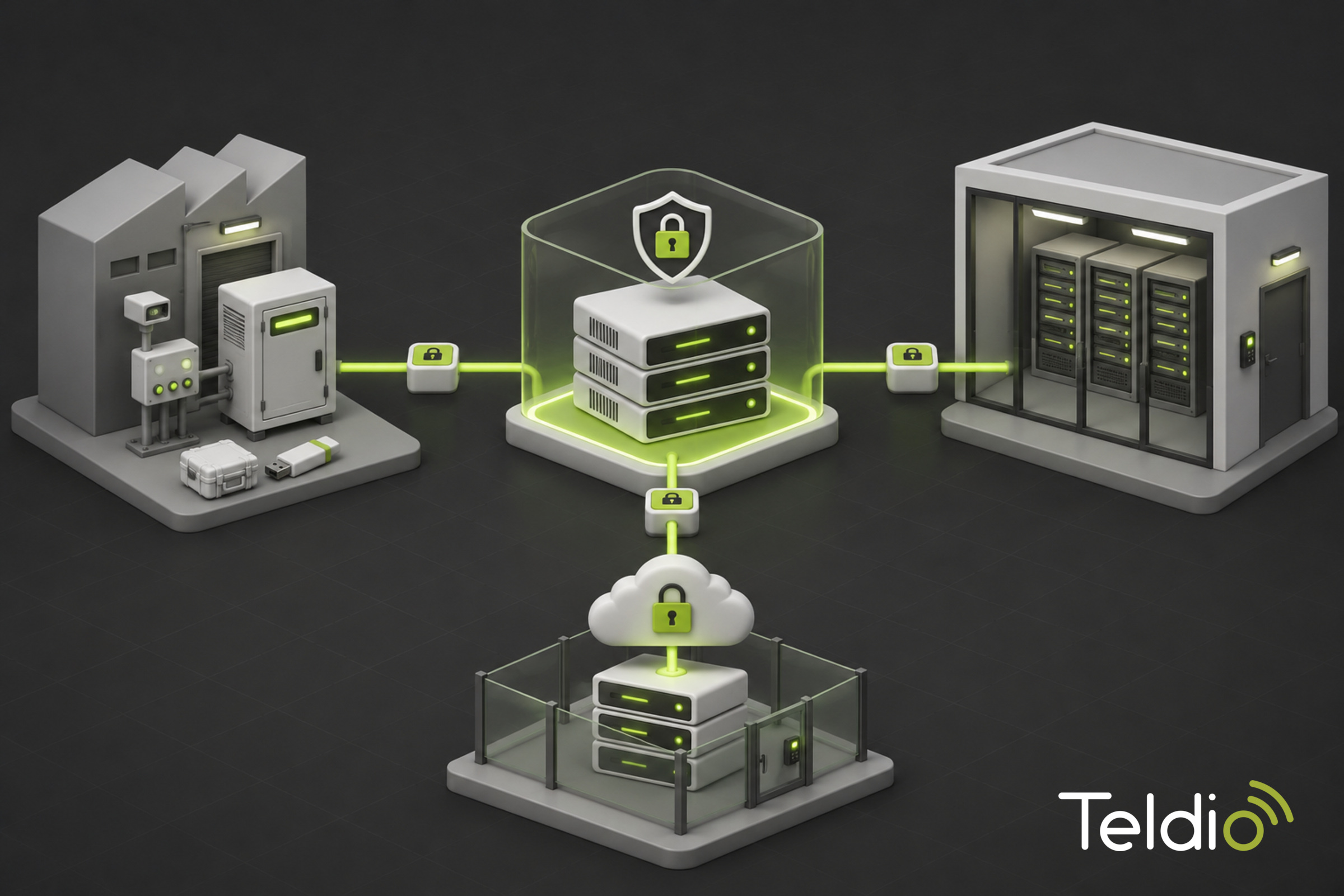
Deployment, hardware, and security requirements for IT teams
TL;DR
Teldio Fabric is a software-based platform that runs on Windows or Linux at the edge, on-premises (including air-gapped environments), or in hybrid deployments in a customer-owned cloud or with a managed service or hosting provider. Teldio does not host Teldio Fabric as a SaaS service. Supported software and API integrations operate without dedicated Teldio hardware, and dry-contact and other wired I/O connections use supported third-party I/O devices, such as those from Moxa.
Which deployment models does Teldio Fabric support?
Teldio Fabric runs on Windows or Linux and supports edge, on-premises, or hybrid architectures. The organization selects the deployment location according to its operational, security, support, and data-handling requirements.
In an on-premises deployment, Teldio Fabric runs inside the customer-managed environment and connects to approved systems through interfaces defined during technical scoping. A hybrid architecture may combine local processing with services or systems supported from outside the local environment. Document host resources, availability design, logging, backups, and recovery requirements for the proposed workload.
Does Teldio Fabric require dedicated hardware?
Teldio Fabric does not require dedicated Teldio hardware. Supported software and API integrations run entirely in software, and Teldio Fabric handles integration logic, event normalization, organization-defined rules, and supported downstream actions.
Physical and legacy connections introduce a different requirement. Dry-contact inputs and outputs and other digital I/O signals connect through supported third-party I/O devices, such as those from Moxa, which Teldio Fabric reaches over the local network. Because these connections stay on the local network, they also suit isolated or air-gapped deployments.
The final hardware design depends on the source systems, destination systems, required actions, physical interfaces, and network boundaries. Radio text, audio, and control workflows must be scoped against the deployed radio architecture, product versions, and licensing.
Which security controls does Teldio Fabric provide?
Teldio Fabric includes built-in security controls for encrypted connections, role-based access, account protection, audit logging, and credential storage. The web interface and API use TLS 1.3. Access is managed through local Fabric accounts with role-based and per-user permissions, account lockout, and sign-in rate limiting. An audit trail records sign-ins, user changes, and configuration changes and can be exported. Passwords are hashed, stored credentials are encrypted, and integration modules are signature-verified before they load.
The security review should confirm how each control applies to the selected modules, host environment, user roles, and connected systems. Teldio provides detailed security documentation to support that review. The deployment model establishes where Teldio Fabric runs. The complete security posture also depends on customer configuration and the surrounding infrastructure.
What remains under customer IT control?
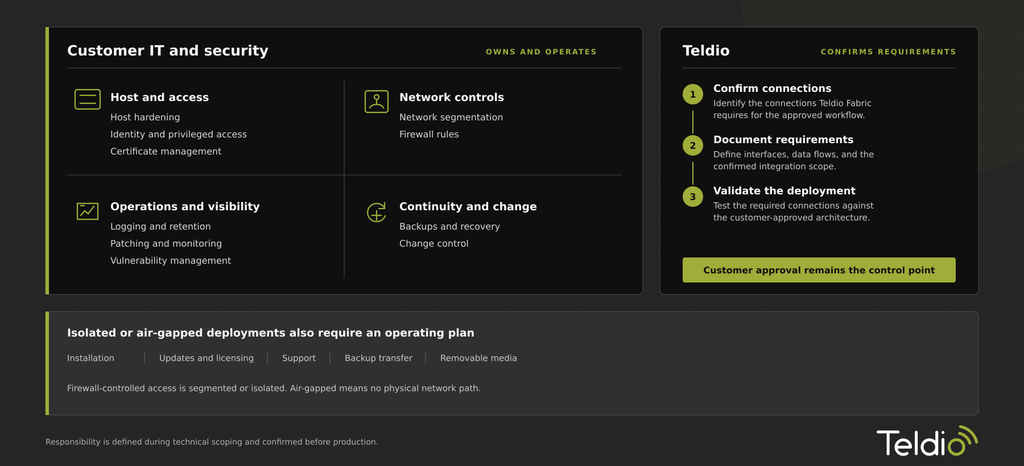
Customer IT and security teams define host hardening, network segmentation, firewall rules, identity and privileged access, certificate management, log retention, backups, patching, monitoring, vulnerability management, recovery, and change control.
An isolated or air-gapped design also requires a documented method for installation, updates, licensing (where applicable), support, backup transfer, and removable media. The term air-gapped should describe the actual network architecture. A deployment connected through controlled firewall rules is more accurately described as segmented or isolated unless a physical air gap exists.
Teldio confirms the connections Teldio Fabric requires. The customer approves those connections within its security architecture and retains control of the surrounding network and host environment. Teldio Fabric runs on infrastructure the customer owns or selects, and Teldio does not host, receive, or retain customer data. Events, logs, and configuration remain in that environment and flow only to systems the customer approves.
What should IT confirm before deployment?
A useful scoping process follows the complete workflow and deployment path:
- Select the host and deployment model. Confirm Windows or Linux; edge, on-premises, or hybrid placement; resource requirements; availability; backup; and recovery expectations.
- Map integrations and network boundaries. Name every source and destination, then confirm the applicable module, API, or protocol, along with ports, authentication, certificates, and permitted data flows.
- Confirm hardware interfaces. Determine whether dry-contact, wired I/O, or legacy connections require a supported third-party I/O device, and confirm where each device sits on the network.
- Assign security and operational ownership. Document administrator roles, credential handling, logging, monitoring, updates, incident support, and change approval.
- Validate before production. Test the source event, normalized data, organization-defined rule, supported action, failure handling, audit record, and recovery procedure.
Product versions, licensing, architecture, and the approved integration scope determine the exact requirements. Record the results as the deployment baseline and repeat relevant tests after changes to a connected system or configuration.
The Teldio angle
A deployment plan should give IT a clear answer to four questions: where the software runs, what it connects to, which hardware is required, and who owns each security control. Teldio scopes those details around the required workflow and documents the validated architecture.
Talk to Teldio about mapping a workflow from the source event to the supported action, including deployment location, network boundaries, hardware interfaces, security controls, and acceptance testing.
Frequently asked questions
Does Teldio Fabric require dedicated Teldio hardware?
No. Supported software and API integrations operate in software. Dry-contact and other wired I/O connections use supported third-party I/O devices, such as those from Moxa.
Where can Teldio Fabric be deployed?
Teldio Fabric runs on Windows or Linux at the edge, on-premises, or in hybrid architectures using a customer-owned cloud, a managed service, or a hosting provider. Technical scoping confirms exact host, availability, and recovery requirements.
Can Teldio Fabric support an isolated or air-gapped environment?
Yes. Teldio Fabric can run fully air-gapped, with licensing and updates applied offline. The complete architecture depends on connected-system, update, and support requirements, so the design must be confirmed during scoping.
Does Teldio Fabric provide security controls?
Built-in controls include TLS encryption, role-based access, account lockout, an audit trail, encrypted credential storage, and signed integration modules. Customer IT retains responsibility for configuration, host and network controls, monitoring, and change management.
Which firewall rules does Teldio Fabric require?
Required connections depend on the selected modules, APIs or protocols, destination systems, and network segmentation. Teldio documents the applicable connections during technical scoping.
Which operating systems does Teldio Fabric support?
Teldio Fabric supports Windows and Linux. Confirm supported versions and resource requirements against the current release and proposed workload.