Connected Operations in Healthcare | Article 3 of 3
Picture this: an access-control server is approaching end of support, but the connected readers and controllers still work. The surrounding security workflow also depends on newer video, dispatch, and radio systems introduced at different times. When a forced-door event occurs, that one workflow crosses multiple vendors, software generations, and lifecycle plans.
For a hospital’s Director of Health System IT & Infrastructure, this means building a component-level modernization path that protects daily operations, addresses urgent risks, retains supportable assets, and coordinates each upgrade or retirement decision.
Assess the Physical and Management Layers Separately
A hospital security environment contains components with different lifecycles. Assess each layer separately:
- An end-of-support management server creates an urgent software and cybersecurity decision.
- Connected readers, controllers, cameras, and radios require their own assessments.
- Document support status, configuration, criticality, recovery options, and risk for each layer.
This separates supportable assets from components that require isolation, upgrade, or retirement.
Sequence Modernization Around Risk and Lifecycle
An enterprise-wide cutover consolidates capital planning, construction, testing, training, cybersecurity review, and integration changes into a single project window.
A phased strategy sequences those decisions. Hospitals address unsupported or high-risk components first, retain compatible assets where operationally and technically appropriate, and assign review dates to everything that remains.
The long-term goal is a supportable architecture with a documented lifecycle decision for every component.
Start with Inventory, Dependencies, and Risk
Before selecting an integration architecture, create a shared view of the environment.
- Document systems, versions, interfaces, owners, data flows, support status, recovery dependencies, critical workflows, and replacement constraints.
- Identify unsupported components, single points of failure, and systems whose outage would affect security operations.
- Confirm compatibility against current vendor documentation and Teldio’s supported integration scope.
The inventory becomes both a technical baseline and a decision record.
Build a Phased Modernization Roadmap
With that baseline established, the hospital can organize the transition into four practical phases:
- Stabilize. Address urgent support and recovery gaps, clarify ownership, and apply approved interim controls.
- Connect. Select one high-value workflow spanning compatible legacy and modern systems, then validate the supported integration points.
- Replace. Prioritize unsupported, high-risk, or operationally limiting components as budgets and implementation windows allow.
- Retire. Remove temporary bridges and outdated platforms according to documented owners and target dates.
A phased approach may allow hospitals to modernize workflows without replacing every compatible controller, endpoint, and field device at once. By default, it should not allow transitional architecture to become permanent.
How Teldio Fabric Can Support the Transition
Once the roadmap is defined, Teldio Fabric can serve as an interoperability and workflow layer between compatible legacy and modern systems. Teldio Fabric connects with more than 200 systems, either natively or through supported protocols. Representative examples relevant to hospital security workflows include:
- Video: Avigilon Unity Video, Genetec, Milestone XProtect, Solink, and Hanwha.
- Access control: Avigilon Unity Access, Alta Access, Gallagher Command Center, Honeywell Pro-Watch, and Honeywell Galaxy.
- Dispatch: Avtec.
- Communications: Motorola MOTOTRBO and WAVE.
Available functions depend on the product version, licensing, deployment architecture, and integration scope confirmed for the project.
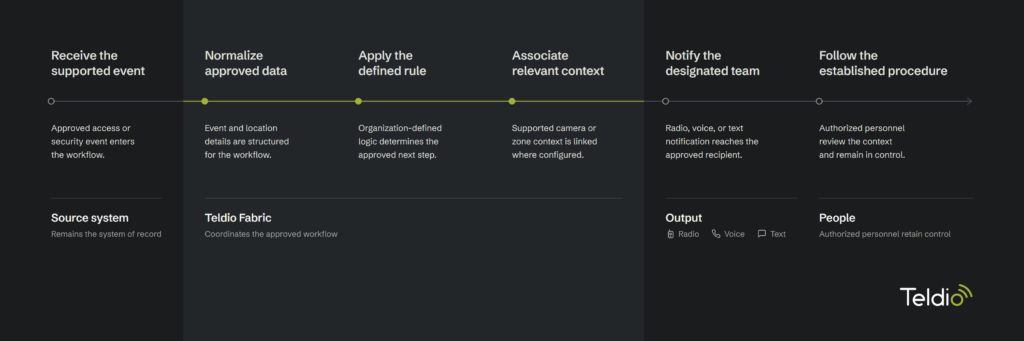
Teldio Fabric ingests approved events, normalizes vendor-specific data, applies organization-defined rules in the Behavior Engine, and routes actions to designated systems and teams. Product version, licensing, architecture, and the approved integration scope determine which functions are available in each deployment.
Consider a supported forced-door event from Honeywell Pro-Watch or Gallagher. Teldio Fabric normalizes the event and location → applies the hospital’s rule → associates the relevant Avigilon Unity camera → delivers the approved notification to a MOTOTRBO group or WAVE user. Teldio Fabric also surfaces the event in Avtec dispatch.
- The access-control platform owns the access event.
- Avigilon Unity owns the video.
- The radio network owns communication. Teldio Fabric coordinates the approved data and actions across them.
Keep Cybersecurity and Governance in Every Phase
Every integration sits inside the hospital’s cybersecurity program.
Network segmentation, access controls, logging, backups, contingency planning, change control, and vendor management follow the hospital’s risk analysis and security architecture. Teams document compensating controls as interim measures and review them on schedule. Before production use, they validate downtime behavior, data handling, ownership, auditability, and rollback plans.
Modernize the Workflow and Manage the Lifecycle
Modernization succeeds through controlled, measurable change.
- Track fewer manual lookups, more consistent event routing, reduced dependence on unsupported servers, clearer system ownership, and progress against the lifecycle roadmap.
- Start with one high-value workflow, confirm its systems of record and supported integration points, and record the lifecycle decision for every component involved.
Talk to Teldio about mapping a phased integration strategy for your hospital’s legacy and modern security systems with Teldio Fabric.
This is the final article in Teldio’s three-part Connected Operations in Healthcare series. Check out the other articles in the Connected Operations in Healthcare Series with article 1 and article 2.