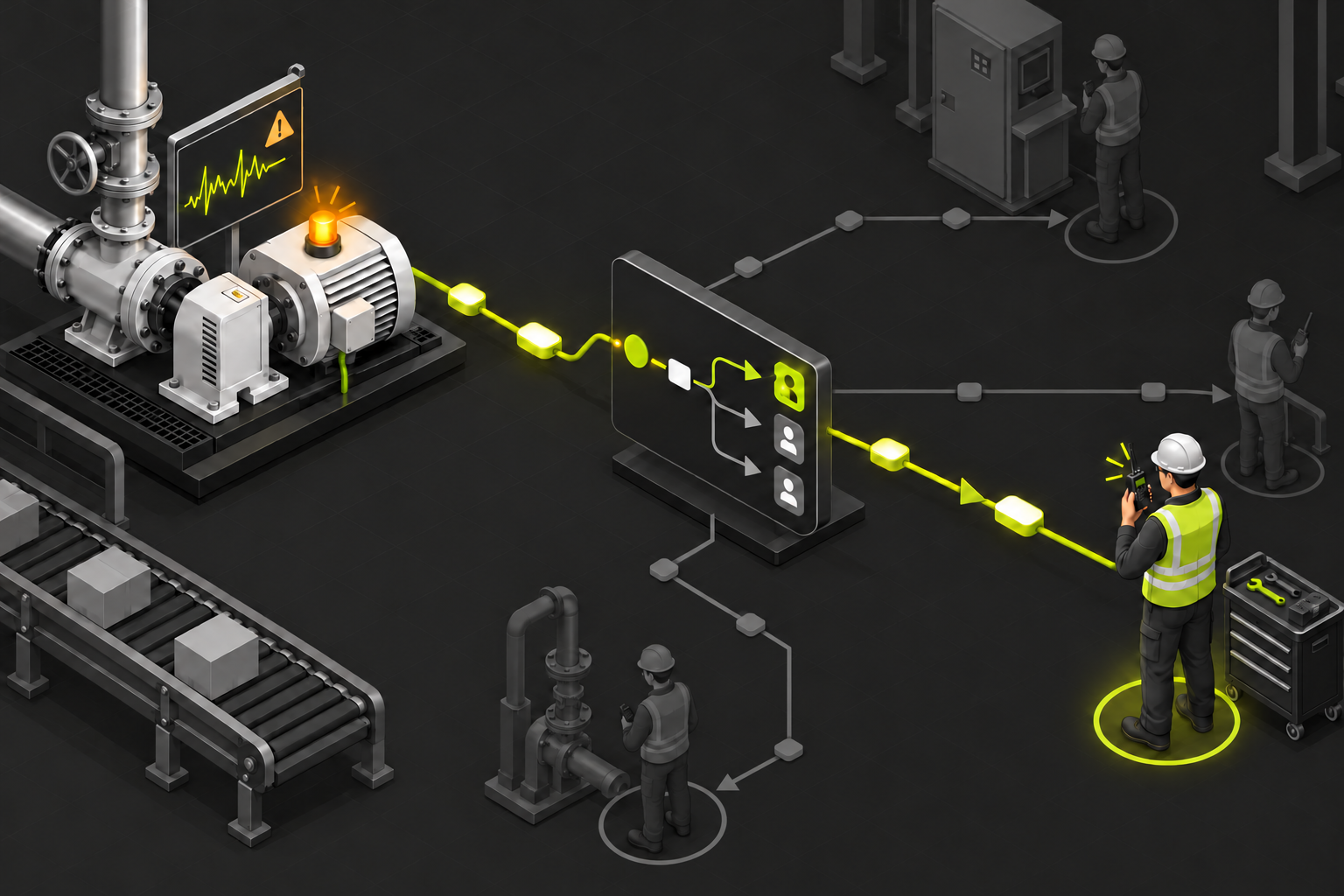
Bridging SCADA to two-way radios without replacing the control system
Connected Operations in Manufacturing | Article 1 of 3
TL;DR
Teldio Fabric routes validated SCADA or PLC fault events to designated maintenance roles through supported communication systems. The source control system remains authoritative. Plant-approved rules determine which events route, what details accompany them, and when an unacknowledged notification escalates to another role.
A machine fault can be visible in seconds and still take several minutes to reach the technician who can act. The delay often appears after detection: an operator reviews the alarm, determines its importance, finds the appropriate maintenance contact, and relays the details by radio or phone.
For a Plant Operations or Maintenance Manager, this means production remains interrupted while the team coordinates a response that the control system has already identified as necessary. Connecting the alert to an approved communication workflow shortens that handoff while the control system retains authority over the equipment.
Where response latency enters the workflow
SCADA and PLC platforms monitor processes and surface abnormal conditions. Maintenance staffing and communication routing often sit outside those platforms. Email and alarm lights provide visibility, but they still depend on someone noticing the event and initiating the next step.
Plants need a selective routing strategy. ISA alarm-management guidance emphasizes that alarms should be meaningful, prioritized, and actionable. An alarm philosophy defines which conditions require operator action. A connected workflow executes those approved decisions while the control system retains responsibility for alarm rationalization.
How a SCADA-to-radio workflow can operate
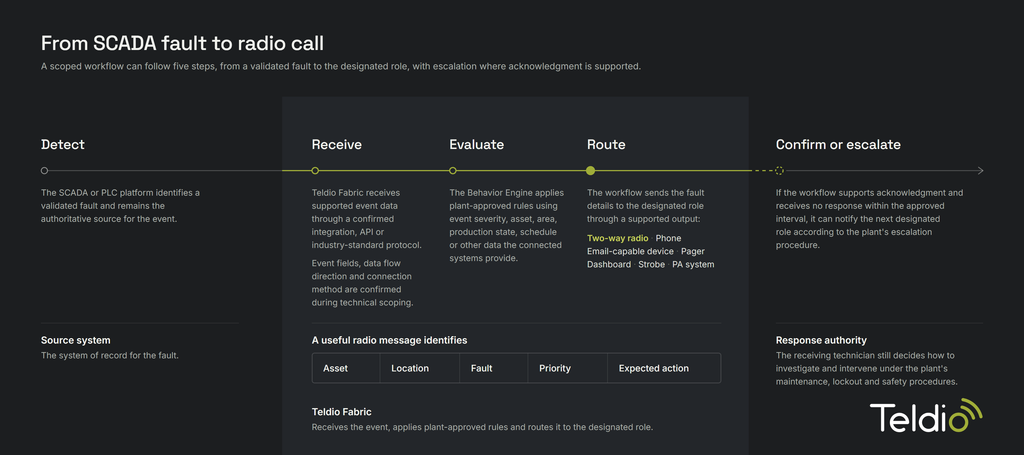
A SCADA-to-radio workflow follows five steps:
- Detect: The SCADA or PLC platform identifies a validated fault and remains the authoritative source for the event.
- Receive: Teldio Fabric receives supported event data through an integration, API, or industry-standard protocol defined during technical scoping.
- Evaluate: The Teldio Fabric Behavior Engine applies plant-approved rules using event severity, asset, area, production state, schedule, or other data the connected systems provide.
- Route: The workflow routes fault details to the designated role through a supported output such as a two-way radio, phone, email-capable device, dashboard, pager, strobe, or PA system.
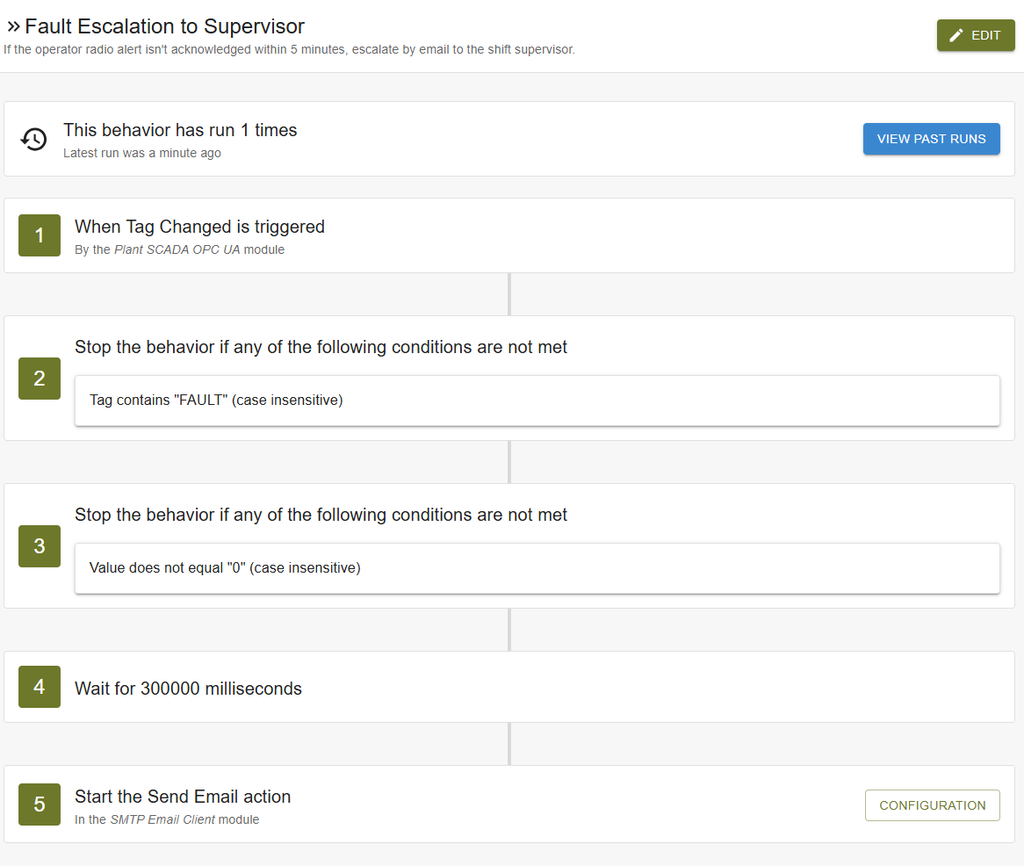
- Confirm or escalate: When acknowledgment is configured, Teldio Fabric monitors for a response. If no response arrives within the approved interval, it notifies the next designated role according to the plant’s escalation procedure.
A useful radio message should identify the asset, location, fault, priority, and expected action. The receiving technician still decides how to investigate and intervene under the plant’s maintenance, lockout, and safety procedures.
What Teldio Fabric does and does not control
Teldio Fabric is a software-based integration and automation platform that connects supported industrial controls, communication systems, and other operational platforms. It runs on Windows or Linux at the edge, on-premises, or in hybrid deployments. It normalizes supported events, applies configured workflow logic, and routes approved actions.
The SCADA platform, PLC, computerized maintenance management system, safety systems, and plant procedures retain their existing roles. Equipment-control commands require a specifically engineered, secured, tested, and approved use case. Technical scoping confirms compatibility, available data, licensing, acknowledgment behavior, and failure modes.
What to confirm before deployment
Operations, maintenance, OT, IT, and safety teams should document:
- Which source events are eligible for routing and which remain local to the control system
- How severity, asset identifiers, locations, and production states are represented
- Which role owns the first response during each shift and who receives an escalation
- Which communication channel and backup path are approved for each event class
- How acknowledgment, duplicate events, loss of connectivity, and recovery are handled
- Which logs must be retained for maintenance review, cybersecurity, and change control
- How the workflow will be tested before it is introduced into production
The practical goal is a documented path from a production-critical event to an accountable responder. Removing avoidable manual handoffs reduces response latency and helps limit preventable downtime. Performance depends on the approved architecture, the quality of the source event, staffing, communications coverage, and the team’s operating procedures.
This post is part of a Connected Operations series, pulling insights from the various projects we’ve worked on. Read more on other industries below and/or talk to Teldio about your or your customers’ needs.
Read Beyond the Alarm Panel: Reducing Response Latency in Hospital Emergency Call-Outs here
Read Priority Without More Noise: Routing Critical Nurse Call Events to the Right Staff here
Read Modernize Without Starting Over: A Phased Integration Strategy for Legacy Hospital Security Systems here